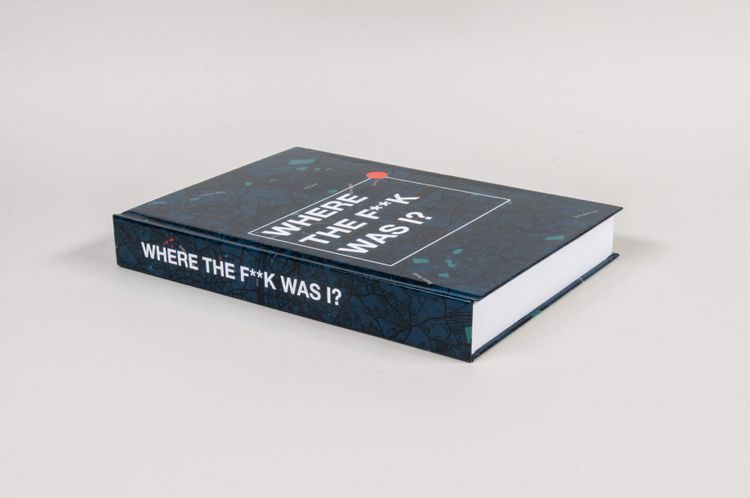
In April 2011, Alasdair Allen and Pete Warden published an article on Radar revealing that Apple has been secretly storing user location data in an unprotected file on each device. After learning about this, James Bridle accessed this file on his phone to retrieve the locations. Where The F**k Was I? presents these location data recorded on the author’s iPhone between June 2010 and April 2011, visualized on 202 maps for each day that data was collected with a total of 35,801 data points. Each map is set on the right-hand side of a double-page spread and is captioned by the date, number of data points, and his activities and destinations on that day, if Bridle remembered them.
By this, Where The F**k Was I? not only becomes a compelling tome of data visualization but also a comparison of the automated memory of the device and Bridle’s own recollection of events. Giving the impression of a very intimate diary, the book triggers reflection on different qualities of memory and their adequacies, as Bridle writes in a blog post about the project: “This digital memory sits somewhere between experience and non-experience; it is also an approximation; it is also a lie. These location records do not show where I was, but an approximation based on the device’s own idea of place, its own way of seeing. They cross-reference me with digital infrastructure, with cell towers and wireless networks, with points created by others in its database. Where I correlate location with physical landmarks, friends and personal experiences, the algorithms latch onto invisible, virtual spaces, and the extant memories of strangers” (James Bridle, “Where the F**k Was I? (A Book),” blog).
In addition, Bridle reappropriates the data secretly stored by Apple and turns it into a commodity in the form of a book that he sells on Lulu for €609 as critique of such practices of surveillance capitalism. With this he makes the selling price of the book part of its artistic conception and message.