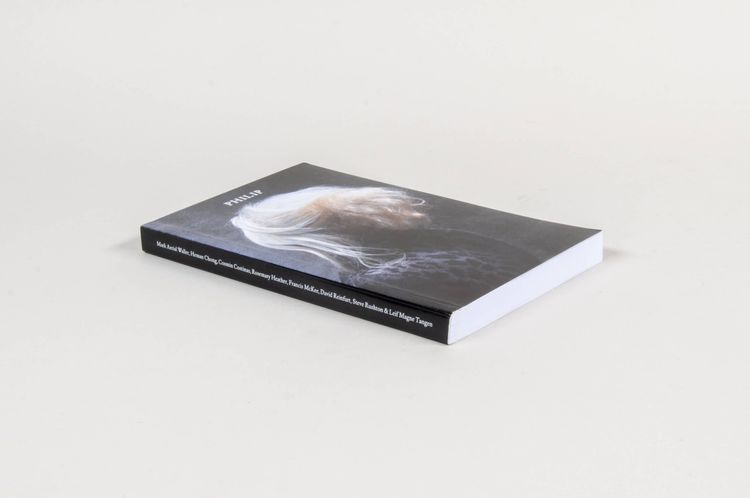
Philip is a collectively written science fiction novel produced during an eight-day writing workshop devised by Herman Chong and Leif Magne Tangen as part of an exhibition of the same name (Project Arts Center, Dublin, November 2006 – January 2007).
The invited participants weren’t writers but graphic designers, filmmakers, visual artists, critics, and curators chosen for their engagement in thinking about the future. The novel they produced, named after Philip K. Dick, is a dystopian narrative set in what was the near future of 2019, trying to preserve the history of the present and at the same time conceptualizing the future, thinking through contemporary modes of production and the dissemination of goods.
The book was designed by Dexter Sinister, the compound name of Stuart Bailey and David Reinfurt. They also took the book’s selling price into consideration, believing that it should be in line with the story’s subject matter: “Because the exhibition format privileges production over display, then it makes sense to price the book based on the immaterial labor costs incurred during the workshop rather than the material, shipping, travel or distribution costs” (Dexter Sinister, “The Price of Philip”).
For the initial print run of 100 copies, they calculated a price of €85.70 per copy, enough to pay all the people involved. For the second edition, they imagined a more relational system with the price being adjusted if the total number of sold copies increased (assuming that the immaterial labor costs are fixed). This would invert the prevailing economy of sale (as more copies are made, the manufacturing costs decrease and the profit per unit goes up) into a demand-side economy of scope, where the profit per unit goes down as production increases. This would increase the circulation of the book outside the circle of participants and create a network of readers.
To make this possible, production on demand and a website and interface are needed. “When an order is placed through this online interface, payment will be collected and a copy of the novel will be printed, bound and shipped by Lulu.com in an already established process. However, the price of a copy will always be re-adjusting—each time an order is placed, the total number of copies is increased and the resulting price is reduced” (Dexter Sinister, “The Price of Philip”).
As this model of using an interface—prior to Lulu’s API—to automatically adjust costs didn’t work, Philip was, after a presumed time of experimentation, sold via Lulu with a more or less fixed price. This third edition is still available and archived in our library.