/ aaaa press is a sublabel of Hartmut Abendschein’s edition taberna kritika (etk), that ran between 2020 and 2022 and published one book every Monday, resulting in 100 publications in total. The series, of the same name, was preceded by an open call with almost no limitations to media and content (“anything which fits in word/pdf”). The resulting publications circle largely around topics like conceptual writing, cataloging and lists, online and off-line text cultures, and fragments and drafts. Each contributor got a free copy.
Apart from its fast-paced publishing routine, the series was subject to further formal constraints resulting from its hybrid publishing model as both PDF and print-on-demand: All publications are DIN A4 (hence the name of the series), softcover, and between 60–800 pages long (the minimum and maximum number of pages possible for being published in this format at Lulu.com).
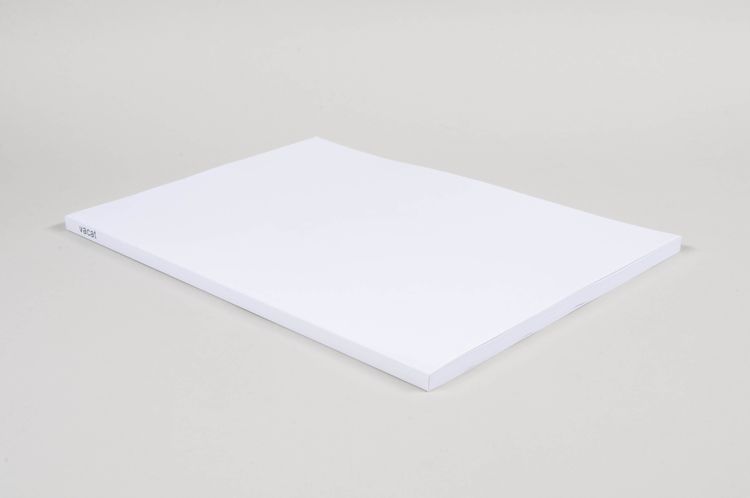
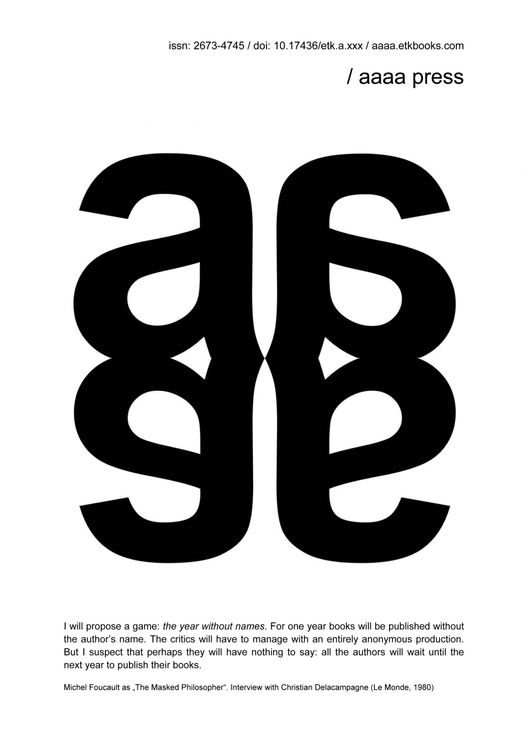
But above all, according to its self-description, / aaaa press is designed as “an allegorical performance of Foucault’s concept ‘the year without names.’” Abendschein refers to a game that Foucault had suggested in an interview: “For one year books will be published without the author’s name. The critics will have to manage with an entirely anonymous production. But I suspect that perhaps they will have nothing to say: all the authors will wait until the next year to publish their books” (Michel Foucault, “Le philosophe masque”). According to this concept of anonymous authorship, / aaaa press makes no reference to any creator of its contents, with the title only showing on the spine (the front and back covers left unprinted) and a very simple title page. Nonetheless, a significant amount of the books can be traced back to Abendschein himself.
The series concludes with an Addendum as No. 100, which lists the DOIs, QR codes, Lulu and cloud links, descriptors, keywords for all publications, and a thesaurus for their tags. The series, which has its own ISSN, is currently archived in Abendschein’s own Google Drive cloud storage. At the same time, the prints are archived by the University Library of Bern and the PDFs by the Swiss National Library. Because all digital publications have a stable DOI, their hosting and distribution could be outsourced to the Swiss National Library’s digital web archive in case of need, thus making the library—without its explicit consent—part of the publishing concept.
In addition, a catalog-exhibition of all publications was created. It contains the witty recommendation: “to get better printed books: download pdfs and re-upload to lulu.com with premium color option” (/ aaaa press, Addendum, [9]). One year later aaaa press [usb.ed] “for researchers, completists & collectors” was released in the form of a USB stick in an edition of 50, including the 100 anonymous PDFs, the exhibition catalog as PDF, and a sticker.
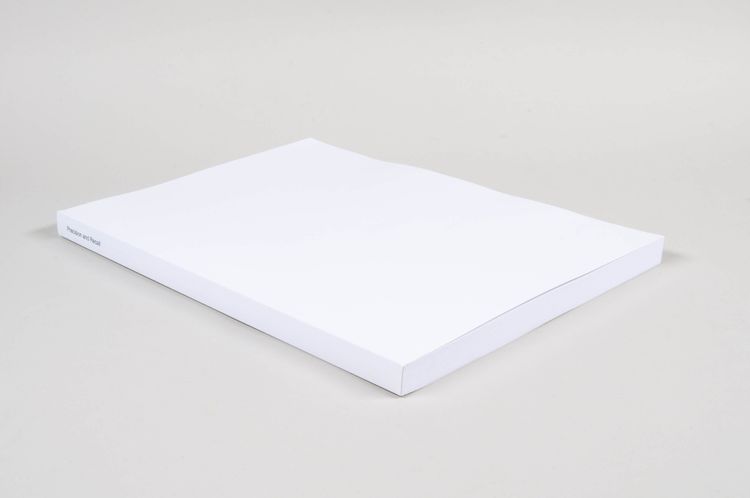
Precision and Recall: Suchbewegung in der Ordnung der Dinge (Search Movement in the Order of Things) goes back to “a reenactment of Foucault’s bibliographic work” by Hartmut Abendschein, which took the form of a “catalog performance” that traced the “navigation through knowledge represented by catalog cards and microforms—the pre-digital scholarly search tools at the time Foucault’s seminal study [The Order of Things] was written” (Hartmut Abendschein, Precision and Recall, i–ii).
Precision and recall are the two parameters usually used to measure the performance (i.e., the quality) of a hit list during an online information search. Precision describes the accuracy of a search result with the proportion of relevant documents in the result set. Recall indicates the proportion of relevant documents found in a search and thus the completeness of a search result. As a librarian, however, Hartmut Abendschein interprets “Precision and Recall” as a “retrieval mechanism” for finding entries in library catalogs that are related to each other by means of a classification system such as the Dewey Decimal Classification (DDC): “From a catalog record with a classificatory entry found, for example, in a library catalog kept alphabetically by author name (a concrete, precise ‘hit,’ that is), further titles can be found in another subject catalog equipped with a classification, which are related to each other in terms of content (recall) and expand the material base of knowledge findings” (Ibid., i).
Accordingly, Abendschein proceeds in two steps: In the old alphabetical catalog of the City and University Library of Bern, which was kept until 1989 and has since been digitized, the authorships from Foucault’s bibliography are systematically researched. In case of a hit, the catalog records with their DDC codes are extracted and mapped in alphabetical order one after the other (part 1: “Precision”). Subsequently, these classification notations were searched in the old subject catalog, which was kept until 1989 and is now only available as a microfiche (part 2: “Recall”). The respective hits (which are often difficult to decipher) are then photographed with the surrounding catalog entries from the fiche and displayed one after the other. This is completed by the bibliography, including all titles from Foucault’s bibliography that could be found in the Bernese alphabetical catalog.
As a surprising side effect, in the “Precision” section there was a “coexistence of different handwritings, typewritings, annotations, and palimpsest productions [...] that themselves illustrate a certain historical development of the catalogs,” while in the “Recall” section “something of the aura” of the now practically extinct microfiche era was captured (Ibid., ii).
Our copy of Precision and Recall is one of the early volumes in the series where Lulu automatically added an in-house barcode to the back cover. When Lulu made a software change in the backend during the run of / aaaa press, and plain / aaaa-style covers could no longer be produced generically, Abendschein switched to crafting the covers himself and adding a hand-generated DOI QR code to the back of all volumes, which also served as a book numbering system. For the sake of uniformity, the PDFs of the first volumes were adapted accordingly afterwards and existing print copies were pasted over with QR code labels. Abendschein also took the opportunity to anonymize the volume by deleting his own name from the title page, which can still be seen in our copy.
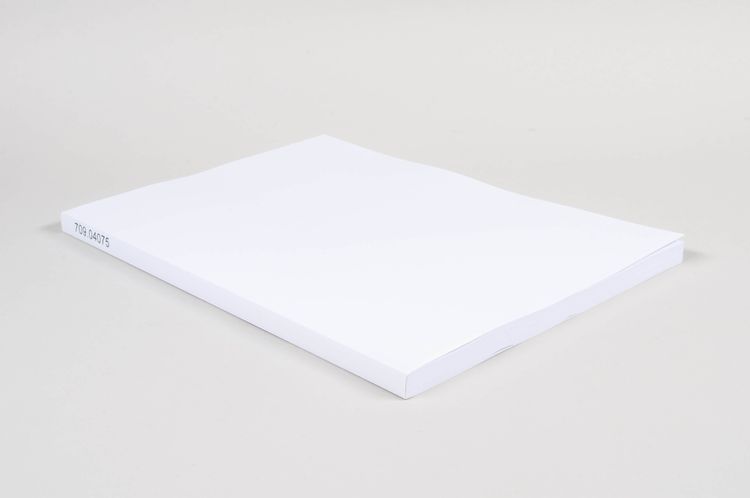
709.04075 is the Dewey classification number for the category “conceptual art”—the acquisition of which Hartmut Abendschein is responsible for at the University Library of Bern. The book lists all 543 entries for items listed under that number including all information provided by the Online Public Access Catalog. Apart from author, publisher, language, format specifications, and identification numbers, this includes content-related information as well as descriptions and keywords. 709.04075 is an index as much as it documents the production of a canon, with a large amount of overlap with items at the Library of Artistic Print on Demand.
Your World of Text is a website made by Andrew Badr in 2009 that provides an infinite grid for collectively editable text. It gained a cult status for online and gaming communities who regularly filled it with all kinds of ASCII art, memes, and shitposting, making it one of the most virtuous collective yet elusive places for visual poetry on the internet. Your World of Text is constantly evolving and changing because anyone can edit anything with no login required. Reading Your World of Text reproduces screenshots taken during a roaming of the website, cropping the infinite text plane first through the lens of the screenshot and then through the lens of the DIN A4 page. Since no backup copy of Your World of Text is made, Reading Your World of Text not only shows the transformation of character-based online art brought back to the printed page, but is also a documenting snapshot of this fluid textual environment.

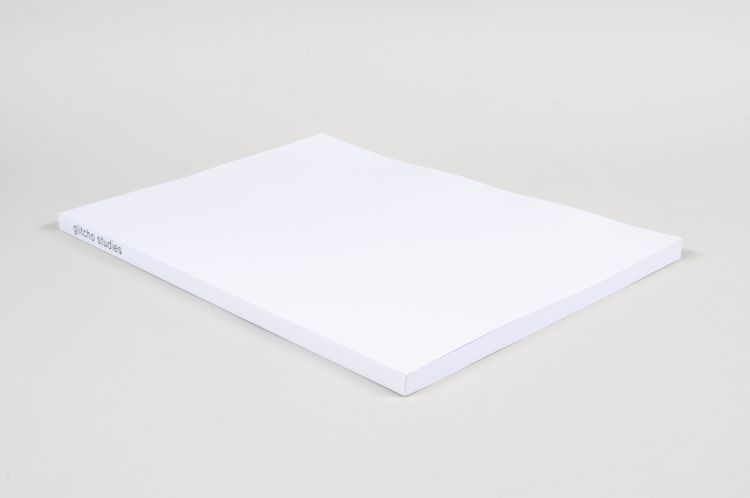
glitcho studies is a collection of 149 portraits photographed with a smartphone from nineteen issues of the periodical Schweizerische Portrait-Gallerie (Swiss Portrait Gallery) between 1893 and 1900, which were then processed with the android app Glitcho – Glitch Video & Photo Editor. The result is not only an automatic alteration, but also a critique of the portrayal of “white cis male dudes,” as the subtitle reads, by adding color to the previously monochrome reproductions of the magazine. All sources are shown at the end of the publication as unaltered photos of their covers. glitcho studies also investigates the range of image analysis and filter techniques offered by the app, which are not glitches in a strict sense of the word but rather automatic alterations that reproduce a certain glitch as aesthetic as it is popular in online cultures.
“a.a.O.” is, as a quoted Wikipedia entry on the last page of the publication informs, an abbreviation for “am angegebenen Ort” or “op. cit.” It is used for shortening the source of a quoted reference but with no real indication as to where the source had previously been quoted—making it an abbreviation that is mostly unused these days. a.a.O. consists of 100 almost identical pages, each with “a.a.O.” in a very big font size on the top of the page and a reference number pointing to a footnote on the next page with the same abbreviation waiting for the reader. The eyes then automatically wander up to the top of the page with the same layout but pointing to the footnote on the successive page. This turning of pages provoked by the reference instructions does not end with the last page either, since the reference there points to the first of the 100 pages, producing a reading loop.

Boot Sounds is a collection of thirty-five boot sounds of famous operating systems, computers, and gaming consoles reproduced as notations for piano. With a range of devices and software going back as far as Apple II and Amiga but stopping in the mid-2000s with Xbox 360, the publication also mimics the creation of a compositional canon of what can almost be considered folklore music by now, sunken deep into the collective subconscious of people exposed to it daily.

A vacat page is a page intentionally left blank in print layouts for different reasons, as a quoted Wikipedia entry at the end of the publication informs. Sometimes such pages are labeled with “This page intentionally left blank” to mark them as not being a print or processing error. vacat reproduces 135 pages carrying this notice reproduced from publications by sound artists and theorists such as John Cage, Steve Reich, Brandon Labelle, and Salom. Voegelin, showing great differences regarding the font and size chosen and its location on the page. All sources are listed at the end of the book, creating a canon of sound artists and musicians. In addition, vacat interprets books as scores for reading, with almost blank pages giving space for a reflection on reading practices, the materiality of the reading device, and the sounds produced while reading and page-turning, reminiscent of John Cage’s 4’33”.
Unlike all the other volumes in the series, this one has an ISBN, the barcode of which, unusually, is not at the very end of the book, but before the bibliography on the page with the final indication “This page was intentionally left blank,” the statement of which it thus ironically undermines. This indicates that it is part of the work. And in fact it is taken from another publication, namely John Cage’s M. Writings ’67–’72.